


Motivation needs proof
Delta over 30–90 days beats hoping the mirror is less harsh today.
Progress system
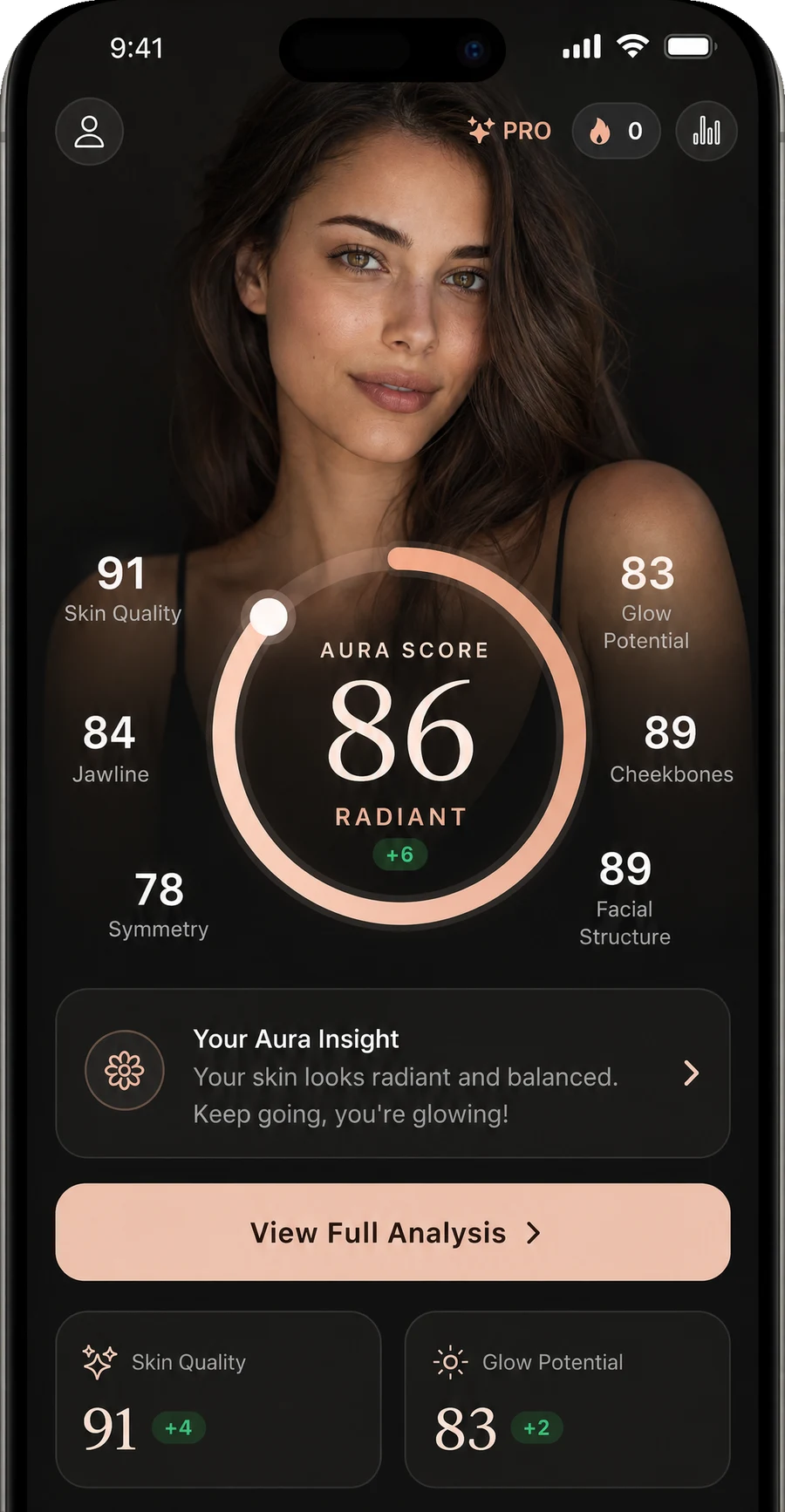
First scan is a baseline. Everything after is a dataset — scores, routines, and side-by-side compare when the gains are real.
Delta over 30–90 days beats hoping the mirror is less harsh today.
Tracking is private by default — your history exists for you, not for an audience.
The right cadence depends on which dimension you are trying to move. Weekly rescans are plenty for skincare experiments: skin quality shifts on a timescale of weeks, so a weekly point under consistent conditions draws a readable line without drowning you in noise. Monthly is better for contour changes driven by body composition, because facial leanness lags fat loss and daily fluctuation is mostly water and sodium. Anything more frequent than weekly mainly measures lighting, angle, and what you ate last night, which is why GlowUp enforces a rescan cooldown rather than letting you scan on impulse — skin barely changes in a day, and a history polluted with impulse scans is harder to read, not easier. Pick a cadence, tie it to a fixed slot like weekend mornings, and let the interval do its job. The gaps between scans are where the progress actually happens.
A glow-up tracker is only as useful as what it records, so it is worth knowing what accumulates in GlowUp over time. Every scan stores the full result: your overall Aura Score, the five dimension scores — Skin Quality, Glow Potential, Contour, Facial Structure, and Symmetry — plus the written summary, your listed strengths, and improvement areas ranked HIGH, MEDIUM, and LOW. The progress chart plots your scores across time so the trend is visible at a glance; the scan timeline lets you open any past result in full; and the before/after compare puts two scans side by side when you want to see how far a month or a season has moved you. Note what is deliberately absent: the photos themselves. Each selfie is deleted right after its results are created, so your history is a record of measurements, not an archive of your face.
It is tempting to treat the scan as the product, but in a real glow-up the scan is just the measurement step. The work happens in the routine: the five-to-eight-step AM/PM plan GlowUp generates from your scan and skin type, tracked daily with streaks. Streaks matter because the entire economics of skincare and presentation favour the consistent over the enthusiastic — a modest routine done every day for six weeks beats an elaborate one done in bursts, and a streak counter makes the boring days feel like they count, because they do. Between scans, the supporting tools keep decisions sensible: the barcode scanner rates any product’s ingredients Safe, Caution, or Avoid against your skin profile before it earns shelf space, and the AI Skin Coach, which knows your latest scan, is there when you are unsure what a score means or which improvement area deserves the next block of effort.
Two failure modes ruin most self-tracking, and a glow-up tracker has to defend against both. The first is noise-chasing: reacting to every dip, concluding a routine has failed because one Tuesday scan came in low. The defence is protocol and patience — same lighting, same angle, same time of day, and judgement reserved for three-to-four-week slopes rather than single points. The second is drift: gradually flattering the inputs, a slightly higher camera here, a sunnier window there, until the “progress” in your chart is progress in photography. The defence is treating your scan setup as fixed equipment, the way a lifter would not celebrate a PR on a shorter bar. Do both and the numbers stay trustworthy, which is the entire point: when your compare view shows a real climb from a Building-band baseline into Balanced or beyond, you want to be certain you earned it.
Yes — pick two points in your timeline and the compare view puts the results side by side, scores included, so a 30- or 90-day delta is something you can see rather than estimate.
Because skin barely changes in a day. The rescan cooldown exists so your history measures real change rather than lighting and water retention. Weekly works for skin experiments; monthly suits body-composition-driven contour changes.
No. Photos are deleted right after each result is created and are never stored, shared, or used for AI training. Your timeline keeps the scores, summaries, and routine history — the measurements, not the images.
First scans typically start in the mid-50s to mid-60s. A realistic 90-day arc is steady movement in your weakest trainable dimension — usually skin quality — pulling the overall Aura Score upwards through the Balanced band. Chasing 90+ Excellent immediately misreads how the scale is built.
Free to start. Scan once, read the six-score breakdown, track what improves.
Free download on iOS and Android.
